
Part of the reason I started this blog is to force myself to open up to all of you in a way that pushes my comfort zone.
I have insecurities about my dance. We all do. One of mine is that I don't have enough costumes. Or, at least, I used to feel like I don't have enough costumes. I wear the same things over and over again, mostly because I don't have a lot of time to make new bras or belts. Inspiration to make new pieces doesn't hit me often, either. It's taken me a while to accept that my lack of new wearables shouldn't detract from my skill as a dancer or performer.
I used to feel pressured to make a new costume item for each big performance of which I was a part, particularly stage shows. I'd see other dancers in the area sporting new creations at each event: beautiful belts, creative costume bras, and other innovative designs. I look at the costuming I wear and realize that I haven't made a new costume bra in a year. I haven't made a new belt in at least 9 months. In the spare time that I have, I'd rather spend it working on my dancing or looking for new music.... let alone relaxing or taking care of daily chores.
Thankfully, there are seamstresses out there (such as Christina of Black Lotus and Tempest of MedDevi Ink) who make amazing and beautiful costuming so that I can buy much more of my costuming than I could several years ago. But this presents a dilemma... the more pretty things that are out there, the more we are tempted to spend money on them rather than our training. I remain frugal in my costume purchases in relation to my spending on training.
It's easy to get wrapped up in the excitement and glitter of wearing a beautiful costume. Many of us dancers are attracted to tribal and fusion dance forms because of their aesthetics, and a key element of those aesthetics is the costuming. Believe me, I want to look my best on stage, and that requires appropriate and professional costuming.
When we first start dancing, we're more likely to get caught up in the "dress-up" element of the dance. We want to wear that flashy hip scarf to class, regardless of how annoying the coins sound or feel under your feet when the threads break. We want to stock up on our stash of shiny things, like magpies building their nests. Believe me, I went through that phase when I first started dancing.
But then I heard this question: Do you spend more money on costuming than you do your training?
Whoa. Reality check!
I remember that being a turning point for me and my approach to this dance. Sure, we want to look good on stage when we perform (and by all means, we should!), but the only way we'll truly look good is if we dance well. The best dancer could go on stage in nothing more than a t-shirt and sweat pants and still blow the crowd away with her skill and projection. (Of course, I'm not suggesting that we all ditch our bedlahs, bras, belts, and hair falls to perform in our pajamas.) A mediocre dancer can wear the most elaborate couture costuming money can buy, but it won't hide her poor technique or stage presence.
So, consider this: the next time you are tempted to buy a hot new costuming item, think about the last time you splurged on a workshop that would improve your technique or projection? A costume is only material, but training will last you a lifetime.
Wednesday, July 16, 2008
The Costume Does Not Make the Dancer

Tuesday, July 8, 2008
On Music. Possibly my first truly controversial post.
I did promise music posts, right?
OK.
So, I was thinking about music (as I often do)...
I have pretty strong feelings about the use of music in dance, particularly when it comes to performing to music to which you've already seen someone else dance. I'm not talking about coincidental use of music that someone else has used, but more along the lines of "Ooh, [Insert name of Famous Dancer or Dancer on YouTube] used this song, and it's great, so I'm going to dance to it too!"
I understand that not everyone agrees with me on my beliefs about music usage. Some people believe that music, regardless of who you've seen dance to it, is fair game. I don't. (And I understand that might not be a very popular opinion, but this blog isn't for popular opinions... Hehe...)
To me, it's an issue of originality and hard work.
I believe music is so inherently part of this dance that the music to which we choose to perform is an extension of our dance and our identity.
I feel that the music a dancer chooses is a part of her because it speaks to her on an emotional level, and she has chosen to use that music to express an intimate part of her emotions and expression. That dancer's music therefore becomes a part of her physical self for that performance (and probably for longer), and she probably worked very hard to find that music, most likely sampling hundreds of songs and purchasing dozens of CDs. Learning a new song takes time and dedication. Finding music takes even more time and probably a good chunk of change.
Music is a financial and emotional investment. I feel like when a dancer performs to a song that she's seen someone else perform to on YouTube, she's not putting in the same investment into her dance that the original dancer did. I also feel that if that dancer performs similarly to the dancer who originally used that music, the dancer is selling her own creativity short by imitating someone else.
Unique music has the power to bring out unique elements of your personality, style, and expression.
There are, however, times when I don't think using "someone else's music" is a bad thing. I've determined that it's OK for you to use music someone else has used if...
- You've asked permission of the dancer using the song if it's OK if you use it as well.
- The music is ubiquitous within the community. For tribal bellydance, ubiquitous artists would be musicians like Helm, Solace, Gypsy Caravan, Raquy and the Cavemen, Maduro, Beats Antique, and Pentaphobe. As more dancers perform, more songs and artists are becoming "standards" of the genre... songs that come to mind are "Proper Hoodidge" by Amon Tobin and a recent new addition to the scene, "Ongyilkos Vasarnap" by Venetian Snares (although as recently as 2005, this song was not a tribal bellydance "standard"). (I believe that it's important to be aware of who these artists are, as many of them make music for dancers or at least with dancers in mind. Give them a little love.) For oriental and cabaret dancers, there are far more "standards" such as "Shashkin", "Alf Layla Wa Layla", "Aziza", "Mishaal", and many more.
- Your performance is VERY different from the dancer who originally danced to that particular song. This generally means that you'll be dancing a different style as the original or using different props.
- The original dancer taught a choreography to that music in a workshop and gave the students permission to perform it elsewhere with credit to the choreographer.
Sometimes it may seem safer to dance to music you know that another dancer has used successfully... That music is already audience-tested and approved. But you'll grow more as an artist if you take a little risk and perform to music that you've never heard anyone else use. Chances are your performance will be a little more heartfelt, and it will certainly be a unique expression of YOU as an artist and dancer.
Tuesday, July 1, 2008
You've Got Style
But you don't have to choose a style right now.
Bellydance is probably the only dance form where the dancers are obsessed with choosing a "style" in their first few years of dancing. I mean, what other dance form do you know that implies that the dancer choose her one and only style by the time she's been dancing for two years? How many times have you heard a new dancer say, "Well, I only dance Egyptian style" or "I don't like cabaret style, so I'm a tribal style dancer"?
Here I make the trite and totally overused ballet vs. bellydance comparison. In this instance, it works.
When you take your first ballet class, you probably aren't taking that class for a particular style of ballet. Every beginning ballet dancer does work at the barre, learns the basic five positions, practices her plie, releve, tendu, and degage. She aims to perfect the basic movements as much as she can. Her instructor isn't pressuring her to dance in a particular style; she's probably pressuring her to be more flexible or keep her back long.
When you take your first ballet class, you don't say, "I only want to dance in The Nutcracker." You don't spend your entire time practicing your movements just to be able to dance in The Nutcracker. You work on your movements so that you can perform any ballet, regardless of composer, era, or style.
In any other dance form, dancers learn technique first. Then they learn choreographies that apply the technique. They continue to work on their technique. They might dance with a company and perform solos with that company. They continue to work on their technique as they learn more choreographies to various styles of music, learning the nuances of dancing to different pieces. Then, maybe, after 15-20 years, does that dance start to really develop her personal style.
Somehow, this approach doesn't apply to bellydance.
Why not?
Why are we bellydancers feeling so pressured to choose a style even before we know how to dance? Why do we succumb to this pressure? Why do dancers who choose a particular style sometimes denigrate styles that are not the one she has chosen? What is it about style that has become so important to us that we feel like we need to choose just one style and stick with it?
Why don't dancers try more styles of bellydance before deciding that she's "tribal" or "cabaret" or "folkloric" or "Turkish" or "Egyptian"? Don't these categories just continue to separate the "fusionists" from the "traditionalists" and widen the divide between them?
And aren't the greatest dancers out there the ones who are masters of their dance, regardless of style?
I don't have answers to these questions. Maybe you do.
Friday, June 27, 2008
Tribe.net - Separating the Grist from the Chaff
I'm sure many of you are familiar with and are perhaps members of tribe.net, an online social networking website that is just chock full of bellydancers. Tribe.net can be a great resource if you just know which tribes to join, however there are a lot of fan tribes that don't offer much substance, and personal/troupe tribes that mostly offer performance and class information for a particular city or area.
To save you some of the hassle of finding the tribes worth paying attention to (in my not so humble opinion), here are the ones that I find the most useful and informative.
- The Biz of Belly Dance
- This tribe is a fantastic resource for dancers who are either dancing professionally or who are seeking to do so in the near future. Moderated by Samira Shuruk--who has been an activist for professional ethics and standards in the bellydance community for several years--this tribe and its members provide quality discussion that rarely becomes uncivil or destructive.
- Bellydance Health, Fitness, and Anatomy
- I've turned to this tribe several times seeking advice and input from other dancers in regard to anatomy and health. While this tribe, of course, is hardly a substitute for seeing a physician, moderator Aubre and its members are chock full of knowledge on the human body and how bellydance affects it.
- Bellydance Feedback
- This tribe, unfortunately, is greatly underutilized. I'd like to see it grow a little bit more. This tribe offers dancers the opportunity to post their own performance videos and solicit constructive feedback from other dancers. Sometimes responses can be confusion, as each dancer might have a different opinion of what would improve a performance, most of the time the responses are honest, helpful, and--as far as I've seen--never hurtful.
- Belly Dance Legacy
- Know your history! This tribe is another great untapped resource. This tribe mostly focuses on the history of bellydance from the 1970s and earlier. I highly suggest you check it out, if only for the amazing photos in the gallery.
- DCTribal
- Created by community maven Mab, just Mab, this tribe serves the DC-area tribal and fusion bellydance scene, but its members span from all over the country. If you're not in DC, then you might not find this tribe as helpful as I do, but if you're ever in the area, this would be the first place to check for upcoming community events, performances, and workshops. This tribe really helped bring together disparate dancers from the area to launch a community in the true sense of the word.
- Suhaila Method Resource Group
- This tribe is limited to those who are at least Level I certified in the Suhaila Salimpour format. If you are Level I certified and haven't joined yet, let moderator Kitiera know that you're interested. It's a fantastic resource for anyone involved in the format.
Are there tribes that you frequent that you feel have helped your dance? Leave a comment. :)
Thursday, June 26, 2008
Gratitude.
I've been trying to express gratitude more often in my daily life. I think it lifts the spirits.
I'd like to say thank you to all the people who've been reading this blog since its inception in February. I appreciate that you take the time to read my ramblings and to leave comments. I read and think about every comment you post.
So... thank you.
Tuesday, June 24, 2008
On Mentoring
I performed in a pretty big show last weekend, involving some pretty reputable dancers (why they invited me, I have no idea!)... and one very respected local instructor asked me as I was about to leave the dressing room for a moment, "Do you have a cover-up? And do tribal dancers wear cover ups? I see a lot of tribal dancers just walking around in their costumes... and I wondered why."
Now, I admit to forgetting a "formal" cover-up on several occasions, but I at least have something to cover myself so that I'm not walking around in full costume.
And I replied to her, "Well, technically, yes, we do wear cover-ups... and I think the dancers you see without them haven't had anyone to tell them otherwise." You see, I think (and I worry) that there is a whole generation of tribal-oriented dancers out there whose primary instruction comes from instructional videos and YouTube... and I worry about these dancers. This is not to say that a dancer can't learn from these media, but it is a rare dancer who can do so. I can think of two.
One reason I worry for these dancers is that if they are learning primarily from videos, then they probably don't have a mentor or a primary instructor to guide them, not only physically to ensure proper technique and body awareness, but also professionally.
I was lucky enough to have a very respected instructor as my professional mentor: Artemis Mourat, from Washington, DC. She took me in after I moved to this area after graduating from college, and taught me nearly everything I needed to know about being not only a dancer, but a professional entertainer. If I had learned only from videos, I probably wouldn't have any idea about asking for a fare wage, always wearing a cover-up, how to conduct oneself when confronted with threatening restaurant owners, and how to dance with a live band. If I had to sum it up, she taught me professional ethics. And I continue to seek her guidance in professional matters to this day. She is a mentor in the true sense of the word. I am grateful that I have such an amazing woman as a resource in my life.
I understand that not all aspiring dancers have such instructors in their areas... and I wonder if it might be worth setting up some sort of mentoring program for dancers... if we could pair up new dancers with experienced ones, and have them establish a relationship either online or over the phone or both. My day job has a program like this, and every new employee is assigned a mentor to help them learn the ropes of the profession. Why don't we have something like this in belly dance?
As we who have been in the dance for a while complain about undercutters who don't know better than to dance for free (*cringe*) or that they should wear a cover-up unless performing, we do very little to combat it. We've been relatively passive, offering guidance to those who seek it, but only after they've sought it, unless those seeking the guidance are our own students. What if we actively sought out "mentees" to coach? Of course, there will always be those dancers who disregard the community at large and will perform and teach before they're ready, but I think we can do more to combat this, particularly as more dancers don't have primary instructors and look to videos for their dance training.
I think I'm going to post about this on the Biz of Belly Dance tribe and see what people say. I'm not sure anyone has thought of this before...
Friday, June 20, 2008
Community Service
In the tribal bellydance world (for some reason this subject doesn't seem to come up as often amongst oriental/cabaret dancers) dancers often bring up the subject of "community". What is community? What happens in your community? How did you find each other? How often do you see each other? Are you friends or just fellow dancers who happen to live in the same area?
For me, community is a lot more than just the dancers who live, perform, teach, and study in your area. There are plenty of areas in the United States where many dancers live in the same region, but hardly ever see each other, and there might even be a sense of animosity that separates them more than physical distance ever could.
There's something bigger at work than just physical proximity that makes a community.
The Oxford English Dictionary offers several definitions for "community", and this one is probably the one most suited to what I'm getting at:
II. A body of individuals.That definition, while close, isn't quite what I'm getting at...
c. Often applied to those members of a civil community, who have certain circumstances of nativity, religion, or pursuit, common to them, but not shared by those among whom they live. [Emphasis mine.]
In the Washington, DC, area, I feel incredibly lucky to be part of a true community. What that means for us is that most of us are friends, we hang out with each other outside of bellydance and similar events, we call on each other for assistance when we need it, and we support each others' endeavors and successes. For the most part we do not see our fellow dancers as competitors, but as colleagues. I feel like we have something very special in this area; I'm not sure other regions or metro areas in the United States can boast such a claim.
That is not to say we don't have intra-community tension sometimes, but it's rare. As we are more like an extended family than a group of people with similar interests, we can take on the characteristics of a classic family with all of its ups and downs.
How did we get here? I think the most important factors in creating community are:
- Leaving your ego and insecurities at home. I think the paramount factors that can ruin a community are insecurity and arrogance. Both trigger responses to others' dancing skill such as, "She's not that good; I can do better", or "Wow, she's really good and I have to compete with her for gigs and attention!" These emotions can also trigger harmful gossip, backbiting, and verbal sabotage. A true community is not about competition against others. (Competition against yourself, however, is perfectly acceptable.)
- Holding and attending events that get everyone in the same space. Sharing your art with others in the same physical space as other dancers and artists in your region is essential to building trust and camaraderie. These events absolutely must be open to anyone who is interested in the artform (in this case, tribal belly dance). Allowing anyone to attend helps emphasize the openness of the individuals who compose the community. When you are at an event where others are present, you must be present as well. It is your chance not only to experience their art, but also to talk to fellow dancers and artists. The more you talk to and associate with others in your region, the less likely you are to succumb to the dangers of insecurity and arrogance.
Of course, there are other variables, but I think these two factors are the key to a really strong community, vice disparate dancers who happen to live in the same general area.
Just as I was to post about community...
Synchronicity! So, if you don't know Mab, just Mab, you really should. She's a cornerstone of the DC dance and performance community, and without her efforts, I'm not sure the DC tribal and related art scenes would be as tight as we are.
She has created a new blog about arts in DC, and I'm pretty sure she's gonna post about every upcoming event related (but not limited) to: Sideshow, Burlesque, Vaudeville, Tribal Bellydance, Fire Artistry, Circus Arts, Unusual Music and Theater... and more! I have a feeling this will be an indespensible resource for events in the area.
The blog: DC Variety. I strongly encourage you to check it out.
Tuesday, June 17, 2008
Inked!
This is really only tangentially related to the overall subject of the blog, but...
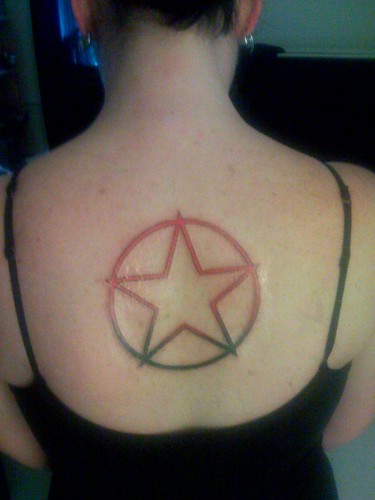
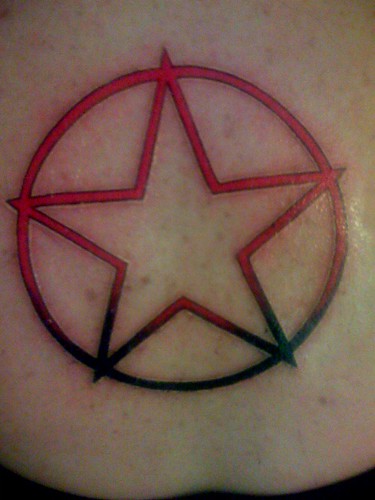
I got new ink!
I've been thinking about this design for over a year. It's an adaptation of the Rush Starman (see below), which first appeared on the back of their album 2112.
The original Starman symbolizes "the abstract man against the masses. The red star symbolizes any collectivist mentality" [Neil Peart, Creem, 1982]. I identified so much with that symbolism and the sentiment behind it. I have felt like an individual fighting the masses... My experiences in elementary school and junior high (see the section on the "No Demon")--particularly being told that I shouldn't try to be the best in school because it was threatening the other students--have been a fundamental building block in my worldview and personal philosophies.

I became really enamored with the image, but I wanted to change it a bit if I were to put it on my body. I took the man out of the original because I feel like the abstract man. The placement of the star on my upper back (vice any other part of my body) is to remind me that the pressure is always there, behind me, and that I must stay true to my convictions regardless of what pressures I face, particularly in my art. I also chose to have it on my upper back because the muscles there are the source of strong dance posture, particularly in tribal style. I feel powerful when I contract my back muscles and stand tall, and that posture conveys a sense of control and confidence.
My entire life I've striven to remain an individual, to not compromise myself in the face of peer pressure, trends, and conformity.
And to give credit where credit is very much due... my tattoo artist is Susan Behney-Doyle at Jinx Proof in Washington, DC. She's amazing, and she made my star a reality.
Wednesday, June 4, 2008
A call for integrity in belly dance periodicals.
Why is it that belly dance periodicals don't seem to pride themselves on well-crafted, objective, and thought-provoking writing, and instead publish poorly-written, subjective, insulting, and inflammatory articles? Are we belly dancers as a community that nasty, ill-educated, catty, and insecure?
I would like to say that on the whole, most of us are well-educated, nice, and generally good people. If an outsider read the most popular of our online periodicals and message boards, she would not get that impression.
This dancer is tired of the poorly written articles that value style over substance and controversy over content.
Here's what I wish for:
- Articles written by dancers who are experts on the subject matters on which they are writing.
- Articles that focus on the art and history of this dance, rather than the gimmicks and controversies.
- Authors who can proofread their own writing, or have the foresight to have a colleague proofread for them.
- Authors who check their facts.
- Authors who can identify and check their assumptions about other styles and dancers.
- Authors who can take the time to spell other dancers' names correctly.
- Authors who, if presented with a DVD or CD to review, have the honesty to tell the periodical, "I am not qualified to review this, so please ask someone else who knows more about this style/subject/dancer."
- Performance and product reviews that are neither hate-fests nor love-fests, but are objective and analytical dissections of the performance or product in question.
- Authors who, if they are offended by a particular style or dancer, do not immediately write an emotionally charged article for the sake of stirring up controversy. We are all passionate about something in this dance, yes, but we don't need to go insulting others to show others how passionate we are.
- In relation to the previous point, authors who, when faced with something that offends them, take the time to understand and conduct some research on the offending style/dancer.
- Authors and articles who don't resort to commenting on the appearance or costuming of a dancer. (Please comment on the quality of the dancing; frankly I don't care if someone was dancing in a baggy sweatshirt and sweatpants or if she's in a $1000 Eman.)
- Publications who seek out quality authors, rather than just allowing their friends and favorite dancers to write articles.
I assume (yes, I could be wrong) that most of the Gilded Serpent's readership is the same population of dancers that lament the passing of the more scholarly paper publications of Habibi and Arabesque, both of which developed a well-earned reputation for well-crafted, well-researched, and honest reporting on our dance. Where are all of those dancers who read these periodicals? Wouldn't you want to see our dance's publications rise up to the high standards that these now defunct periodicals set? Or did these publications perish because we as a community don't really have an appetite for academic research and writing on our dance? I would hope that isn't the case, but I fear that the passing of these magazines indicates that our community would rather wallow in insults and subjective ass-kissing and back-biting than to take the high road of objectivity, research, and integrity in our written products.
