
I've been trying to express gratitude more often in my daily life. I think it lifts the spirits.
I'd like to say thank you to all the people who've been reading this blog since its inception in February. I appreciate that you take the time to read my ramblings and to leave comments. I read and think about every comment you post.
So... thank you.
Thursday, June 26, 2008
Gratitude.

Tuesday, June 24, 2008
On Mentoring
I performed in a pretty big show last weekend, involving some pretty reputable dancers (why they invited me, I have no idea!)... and one very respected local instructor asked me as I was about to leave the dressing room for a moment, "Do you have a cover-up? And do tribal dancers wear cover ups? I see a lot of tribal dancers just walking around in their costumes... and I wondered why."
Now, I admit to forgetting a "formal" cover-up on several occasions, but I at least have something to cover myself so that I'm not walking around in full costume.
And I replied to her, "Well, technically, yes, we do wear cover-ups... and I think the dancers you see without them haven't had anyone to tell them otherwise." You see, I think (and I worry) that there is a whole generation of tribal-oriented dancers out there whose primary instruction comes from instructional videos and YouTube... and I worry about these dancers. This is not to say that a dancer can't learn from these media, but it is a rare dancer who can do so. I can think of two.
One reason I worry for these dancers is that if they are learning primarily from videos, then they probably don't have a mentor or a primary instructor to guide them, not only physically to ensure proper technique and body awareness, but also professionally.
I was lucky enough to have a very respected instructor as my professional mentor: Artemis Mourat, from Washington, DC. She took me in after I moved to this area after graduating from college, and taught me nearly everything I needed to know about being not only a dancer, but a professional entertainer. If I had learned only from videos, I probably wouldn't have any idea about asking for a fare wage, always wearing a cover-up, how to conduct oneself when confronted with threatening restaurant owners, and how to dance with a live band. If I had to sum it up, she taught me professional ethics. And I continue to seek her guidance in professional matters to this day. She is a mentor in the true sense of the word. I am grateful that I have such an amazing woman as a resource in my life.
I understand that not all aspiring dancers have such instructors in their areas... and I wonder if it might be worth setting up some sort of mentoring program for dancers... if we could pair up new dancers with experienced ones, and have them establish a relationship either online or over the phone or both. My day job has a program like this, and every new employee is assigned a mentor to help them learn the ropes of the profession. Why don't we have something like this in belly dance?
As we who have been in the dance for a while complain about undercutters who don't know better than to dance for free (*cringe*) or that they should wear a cover-up unless performing, we do very little to combat it. We've been relatively passive, offering guidance to those who seek it, but only after they've sought it, unless those seeking the guidance are our own students. What if we actively sought out "mentees" to coach? Of course, there will always be those dancers who disregard the community at large and will perform and teach before they're ready, but I think we can do more to combat this, particularly as more dancers don't have primary instructors and look to videos for their dance training.
I think I'm going to post about this on the Biz of Belly Dance tribe and see what people say. I'm not sure anyone has thought of this before...
Friday, June 20, 2008
Community Service
In the tribal bellydance world (for some reason this subject doesn't seem to come up as often amongst oriental/cabaret dancers) dancers often bring up the subject of "community". What is community? What happens in your community? How did you find each other? How often do you see each other? Are you friends or just fellow dancers who happen to live in the same area?
For me, community is a lot more than just the dancers who live, perform, teach, and study in your area. There are plenty of areas in the United States where many dancers live in the same region, but hardly ever see each other, and there might even be a sense of animosity that separates them more than physical distance ever could.
There's something bigger at work than just physical proximity that makes a community.
The Oxford English Dictionary offers several definitions for "community", and this one is probably the one most suited to what I'm getting at:
II. A body of individuals.That definition, while close, isn't quite what I'm getting at...
c. Often applied to those members of a civil community, who have certain circumstances of nativity, religion, or pursuit, common to them, but not shared by those among whom they live. [Emphasis mine.]
In the Washington, DC, area, I feel incredibly lucky to be part of a true community. What that means for us is that most of us are friends, we hang out with each other outside of bellydance and similar events, we call on each other for assistance when we need it, and we support each others' endeavors and successes. For the most part we do not see our fellow dancers as competitors, but as colleagues. I feel like we have something very special in this area; I'm not sure other regions or metro areas in the United States can boast such a claim.
That is not to say we don't have intra-community tension sometimes, but it's rare. As we are more like an extended family than a group of people with similar interests, we can take on the characteristics of a classic family with all of its ups and downs.
How did we get here? I think the most important factors in creating community are:
- Leaving your ego and insecurities at home. I think the paramount factors that can ruin a community are insecurity and arrogance. Both trigger responses to others' dancing skill such as, "She's not that good; I can do better", or "Wow, she's really good and I have to compete with her for gigs and attention!" These emotions can also trigger harmful gossip, backbiting, and verbal sabotage. A true community is not about competition against others. (Competition against yourself, however, is perfectly acceptable.)
- Holding and attending events that get everyone in the same space. Sharing your art with others in the same physical space as other dancers and artists in your region is essential to building trust and camaraderie. These events absolutely must be open to anyone who is interested in the artform (in this case, tribal belly dance). Allowing anyone to attend helps emphasize the openness of the individuals who compose the community. When you are at an event where others are present, you must be present as well. It is your chance not only to experience their art, but also to talk to fellow dancers and artists. The more you talk to and associate with others in your region, the less likely you are to succumb to the dangers of insecurity and arrogance.
Of course, there are other variables, but I think these two factors are the key to a really strong community, vice disparate dancers who happen to live in the same general area.
Just as I was to post about community...
Synchronicity! So, if you don't know Mab, just Mab, you really should. She's a cornerstone of the DC dance and performance community, and without her efforts, I'm not sure the DC tribal and related art scenes would be as tight as we are.
She has created a new blog about arts in DC, and I'm pretty sure she's gonna post about every upcoming event related (but not limited) to: Sideshow, Burlesque, Vaudeville, Tribal Bellydance, Fire Artistry, Circus Arts, Unusual Music and Theater... and more! I have a feeling this will be an indespensible resource for events in the area.
The blog: DC Variety. I strongly encourage you to check it out.
Tuesday, June 17, 2008
Inked!
This is really only tangentially related to the overall subject of the blog, but...
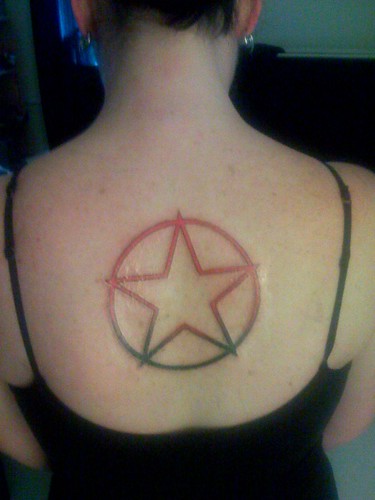
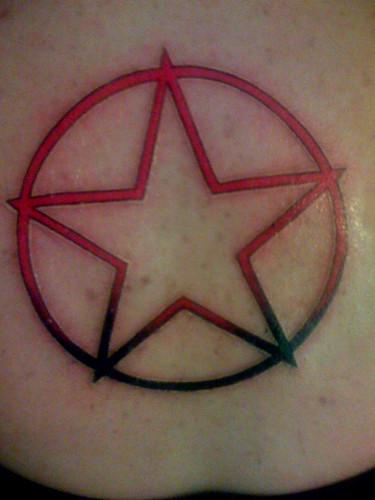
I got new ink!
I've been thinking about this design for over a year. It's an adaptation of the Rush Starman (see below), which first appeared on the back of their album 2112.
The original Starman symbolizes "the abstract man against the masses. The red star symbolizes any collectivist mentality" [Neil Peart, Creem, 1982]. I identified so much with that symbolism and the sentiment behind it. I have felt like an individual fighting the masses... My experiences in elementary school and junior high (see the section on the "No Demon")--particularly being told that I shouldn't try to be the best in school because it was threatening the other students--have been a fundamental building block in my worldview and personal philosophies.

I became really enamored with the image, but I wanted to change it a bit if I were to put it on my body. I took the man out of the original because I feel like the abstract man. The placement of the star on my upper back (vice any other part of my body) is to remind me that the pressure is always there, behind me, and that I must stay true to my convictions regardless of what pressures I face, particularly in my art. I also chose to have it on my upper back because the muscles there are the source of strong dance posture, particularly in tribal style. I feel powerful when I contract my back muscles and stand tall, and that posture conveys a sense of control and confidence.
My entire life I've striven to remain an individual, to not compromise myself in the face of peer pressure, trends, and conformity.
And to give credit where credit is very much due... my tattoo artist is Susan Behney-Doyle at Jinx Proof in Washington, DC. She's amazing, and she made my star a reality.
Wednesday, June 4, 2008
A call for integrity in belly dance periodicals.
Why is it that belly dance periodicals don't seem to pride themselves on well-crafted, objective, and thought-provoking writing, and instead publish poorly-written, subjective, insulting, and inflammatory articles? Are we belly dancers as a community that nasty, ill-educated, catty, and insecure?
I would like to say that on the whole, most of us are well-educated, nice, and generally good people. If an outsider read the most popular of our online periodicals and message boards, she would not get that impression.
This dancer is tired of the poorly written articles that value style over substance and controversy over content.
Here's what I wish for:
- Articles written by dancers who are experts on the subject matters on which they are writing.
- Articles that focus on the art and history of this dance, rather than the gimmicks and controversies.
- Authors who can proofread their own writing, or have the foresight to have a colleague proofread for them.
- Authors who check their facts.
- Authors who can identify and check their assumptions about other styles and dancers.
- Authors who can take the time to spell other dancers' names correctly.
- Authors who, if presented with a DVD or CD to review, have the honesty to tell the periodical, "I am not qualified to review this, so please ask someone else who knows more about this style/subject/dancer."
- Performance and product reviews that are neither hate-fests nor love-fests, but are objective and analytical dissections of the performance or product in question.
- Authors who, if they are offended by a particular style or dancer, do not immediately write an emotionally charged article for the sake of stirring up controversy. We are all passionate about something in this dance, yes, but we don't need to go insulting others to show others how passionate we are.
- In relation to the previous point, authors who, when faced with something that offends them, take the time to understand and conduct some research on the offending style/dancer.
- Authors and articles who don't resort to commenting on the appearance or costuming of a dancer. (Please comment on the quality of the dancing; frankly I don't care if someone was dancing in a baggy sweatshirt and sweatpants or if she's in a $1000 Eman.)
- Publications who seek out quality authors, rather than just allowing their friends and favorite dancers to write articles.
I assume (yes, I could be wrong) that most of the Gilded Serpent's readership is the same population of dancers that lament the passing of the more scholarly paper publications of Habibi and Arabesque, both of which developed a well-earned reputation for well-crafted, well-researched, and honest reporting on our dance. Where are all of those dancers who read these periodicals? Wouldn't you want to see our dance's publications rise up to the high standards that these now defunct periodicals set? Or did these publications perish because we as a community don't really have an appetite for academic research and writing on our dance? I would hope that isn't the case, but I fear that the passing of these magazines indicates that our community would rather wallow in insults and subjective ass-kissing and back-biting than to take the high road of objectivity, research, and integrity in our written products.
Sunday, May 25, 2008
More words of wisdom from Mr. Peart
My favorite rock drummer, Neil Peart, says this on one of his instructional DVDs:
"Be inspired by your accomplishments and not threatened by your limitations."
I like that!
Hearing that made me think about my own accomplishments and limitations as a dancer and artist. I feel like I have a few accomplishments, achievements that I'm proud of and that I worked really hard to attain. And then I thought of my limitations. My main limitation is time. There's never enough time in the day for me to accomplish all that I want with my art. Sometimes I do feel threatened by my limitations, but I have to look at them as not hindrances but a framework: How much can I do within these boundaries? How much can I push myself within the box of my own schedule and my own limits?
I think as artists it's really easy to be discouraged by those elements of our lives that appear to hold us back from really flourishing.
What do you feel limits you? What are your accomplishments as an artist and as a human? Take a moment to reflect and maybe your limitations are guidelines in disguise.
Wednesday, May 21, 2008
Returning from my fourth Tribal Fest
Tribal Fest. It's like the (pardon the analogy) Mecca of tribal and fusion bellydance. It's where we go to learn from and watch the "stars", and it's where new stars are born and discovered.
And for a little less than a week, you can immerse yourself in this world of fantasy and individuality, if you go in with the right attitude.
It's easy to get wrapped up in the glitz and glitter and infinite searches for "fame." Frankly, there's a whole lot of ass-kissing and schmoozing that goes on at a festival like this one. So many people wanting to talk to the more famous dancers, to have their troupe noticed by the big names, and to get that latest hip (haha... punny!) pair of Melodia pants.
I've inadvertently been sucked into the materialism and external focus that is so prevalent at large gatherings such as this one. It's easy for me to feel like the odd one out, the outsider who isn't cool enough to hang with the popular kids... it's a complex I've had since elementary school... This sense of not being able to relate and feeling like I need to keep up with the Joneses of tribal belly dance leaves me feeling inadequate, inexperienced, and disconnected... not only from the "scene" but myself. It also doesn't help that I'm introverted and have a hard time feeling comfortable around large groups of people, particularly when I don't know most of them.
This year I made a conscious decision to make the most of my time at the fest, regardless of what happened. I think it worked!
I took time away from the fest when I needed to be isolated, and I spent a a leisurely amount of time getting ready for my performance on Friday night. When I got to the festival venue after finishing my hair and make up, I spent at least an hour and a half walking around with my earphones on, listening to Rush (of course!) and just centering myself. I had a few one-on-one conversations with vendors about music and dance and integrity, which also helped to boost my confidence a little bit more. I think that this time alone, in my own little world of music, helped me deliver (what I thought was) a solid performance that night.
I spent the remainder of the festival with my friends, spending time with people who I hadn't seen in months, sometimes years, and enjoying the warmth of the northern California sun. I spent money on things that I knew I would use, not just because they were the "cool new things".
If you look past all the shiny things on the vendors' tables and find a sense of peace within yourself and your abilities as a dancer and as a human being, chances are you'll be less likely to be sucked into the vortex of activity at such a large festival as Tribal Fest. Everyone has a different festival experience, and it's up to you to choose how you approach and spend your time. This year, I feel like I chose very wisely.
Thursday, May 8, 2008
Fly by night away from here.
The Paladin will be away for about a week... I'm sure that after I return from Tribal Fest, I'll have more thoughts to share with you all.
Thanks for reading. :)
Sunday, May 4, 2008
On being a performer.
A stream of consciousness post for a Sunday morning...
I think the hardest part of being a dancer for me is also being a performer. I get a little self-absorbed, and not in a "I'm so awesome" kind of way, but in that I forget that there are others watching me perform. If I'm not in the right headspace, I don't project as much emotion to the audience as I should or could. And then the audience doesn't follow me on my journey on stage.
I am an introvert. I have a hard time connecting with people in general, and when I'm putting myself on stage, expressing very personal elements of myself as a dancer and artist, I feel very vulnerable.
What really helped open my eyes was taking a workshop with Sera, formerly of Washington DC and now in New York. She said that when we're on stage we must "give our throat to the wolves" - basically we have to forget our fears and open ourselves up to the audience, no matter how cruel or aloof they might be.
I've always been a technical dancer - the skill of dancing has come rather easily to me, but connecting with the audience has always been a challenge. I think it's a challenge for most dancers who aspire to also be performers. It's much easier to go out there, do some tricks, and then walk off stage... but to really connect with the audience, to give them a piece of yourself, your soul, is so much different... and it's scary!
What I see in a lot of newer dancers is that they have not yet learned how to project, to give themselves to the audience. Being able to project means being confident in your technical abilities that they become second nature... it's like an actor knowing her lines so well that she doesn't have to think about them anymore and she can become the character that she's portraying.
Recently I've been focusing more on getting into that emotional place than on drilling technique, so that I can just dance "in the moment" and yet still give myself to the audience.
What has really helped me is eye contact. I used to be so afraid of looking people in the eyes, even when not on stage. Honestly, sometimes I fake eye contact when on stage. I'll look between people, and not really at anyone, but it looks like I'm staring someone down. I'm trying to get better at this and really look right at people in the audience. It makes them smile, and it makes me smile. Both good things when on stage!
I also try to spend some time alone before the performance, getting into an emotional place. If I don't have that time before a performance to settle into my "character", the piece isn't going to be as successful, and I have a harder time controlling my emotional projection on stage. When creating a piece, I try to have a particular mood or character that I'm portraying, and these are always a part of myself. I never portray a character that isn't inherent in my own personality.
And while I'm on stage, I have to believe and know that I am in control: of my movements, my expression, and the audience. They are my captives... otherwise they wouldn't be there. It's a delicate balance... because if you try too hard for their attention, it will slip away. The audience will know that you're trying to hard and then they won't take you seriously. But if it's obvious that you're enjoying yourself and loving what you do up on stage, they'll go along with you for the journey. It's very zen. It's trying without effort.
The most useful way to become a performer is, of course, getting performance experience. Nothing will teach you most about being on stage than actually being on stage. You can read all about emotional expression all you want, but if you don't actually perform, none of that intellectual knowledge will do you any good.
Where are you in this process? Is connecting with the audience something that comes naturally for you or not? What do you do to help you with this aspect of performance?
Subscribe to:
Posts (Atom)
