Showing posts with label self-reflection. Show all posts

Sunday, November 30, 2008

Digging in the dirt...

When Kajira asked me to teach a "gothic" workshop at Tribal Fest this year, I didn't really know what to offer. I don't consider myself just a gothic bellydancer, although that seems to be the label that others often put on me. I don't mind, really; I do tend towards darker themes and costuming, so the label is understandable. However, despite being attracted to the darker side of things, I think my style encompasses more than "gothic". And as far as teaching any sort of authoritative workshop on gothic styling, costuming, or music, I could name several dancers and artists who are much more qualified to do so. I think the reason Kajira asked me to teach a "gothic" workshop is because my performance at Tribal Fest 8 last May was quite dark.

That performance was rooted in a lot of personal anger and frustration that I had been dealing with as an artist and as an individual. In order to perform that piece, I did a lot of introspection and soul-searching. The specific meaning behind the piece is, of course, personal. I had to face my fears, my insecurities, and my ever-present and often destructive Ego in order to work up the gall to share that with the world. I often describe that piece as "One girl confronting and conquering her demons."

Demons...

The concept of personal demons has fascinated me since high school. Personal demons are the aspects of our own selves that we fear, that we don't want to accept, and that we don't want the rest of the world to see. They are our ugly parts, our sources of shame, anger, and fear. They are remnants of our past that we'd rather not remember, that we'd rather just push away. All of us have them, but only some of us choose to face them, and even fewer use them in our art. And the more you push them down, the stronger and less controllable they can become.

I believe the best art is made from the deepest and darkest demons. So, just as I had to reach deep inside my psyche to present my TF8 performance, maybe I can help others face, confront, and tame their darker sides, their Jungian Shadow archetype. I've also confronted (but by no means have I fully reconciled it--I'm not sure one ever does) my Demons and Shadow face-to-face several times in Suhaila Salimpour's workshops, particularly this past August during the Level III weeklong. I think I have some insight on how to use the darker aspects of ourselves to create a more powerful, more emotional, and more honest performance.

If we can't face the dark sides of ourselves, we will continue to never fully recognize our complete emotional range... and if we can't recognize our emotional range, how can we ever present a compelling performance to an audience who, whether they know it or not, are desperately seeking a connection with the artist on stage. The more you can face your demons, the more you can not only connect with yourself, but with every single person who sees you perform. And isn't making that sublime connection with others something that makes art ART?

Today, I'll leave you with this excerpt from Jung's writings on the Shadow.

We know that the wildest and most moving dramas are played not in the theatre but in the hearts of ordinary men and women who pass by without exciting attention, and who betray to the world nothing of the conflicts that rage within them except possibly by a nervous breakdown. What is so difficult for the layman to grasp is the fact that in most cases the patients themselves have no suspicion whatever of the internecine war raging in their unconscious. If we remember that there are many people who understand nothing at all about themselves, we shall be less surprised at the realization that there are also people who are utterly unaware of their actual conflicts.

"New Paths in Psychology" (1912). In CW 7: Two Essays on Analytical Psychology. P.425

Saturday, October 25, 2008

Returning after a long hiatus.

Greetings, dear readers... I know I have abandoned you for quite a while, but this Modern Day Warrior has been... busy. Very very busy. And because I've been so busy, I haven't had any ponderings that I thought worthy of the blog. I've been hosting, attending, and teaching workshops in addition to my day-to-day teaching weekly classes, working full time, and trying to spend some quality time with my husband... let alone some quality time alone.

One thing I have been doing that has been incredibly calming is drawing... My husband signed me up for a 9-week session of figure drawing class at the Art League in Alexandria. Once a week, I enter the studio, giant sketch pads in hand, and clear my head.

It's like yoga for my mind. I don't have to worry if my drawings are good or what others will think of them. I just focus, and everything else slips away... I spend those 2 and a half hours a week looking at how the shadows form on the model's body, seeing how the muscles and joints connect together, shading here, erasing and lightening there. Why didn't I do this before?

I used to draw all the time. Any free moment I had was spent with my sketchbook (a 9x12 Strathmore recycled sketch, with the green cover). When I draw, the world slips away.

I've posted a few of my sketches (from a visit to the New England Aquarium and some other random things) on Flickr, for those who'd like to see. They're nothing spectacular, but it will give you an idea of what I do. While dance is a job (albeit one I absolutely love), when I draw I don't have to worry about what others will think or whether that performance will end up on YouTube.

Do you have something that just makes the world slip away, where you feel no pressure, no anxiety, and no one but yourself? Drawing makes me feel like that.

Tuesday, September 9, 2008

You are your own style.

Following up to "You got Style" - I was thinking about dancers who feel pulled in multiple directions and who have many influences... and we feel pressured to choose one particular style or integrate all our style influences in a way that might be forced or artificial. There is no reason why you and your personal style of movement can't evolve or change as you grow and learn.

I thought that I wanted to be an Ultra Gypsy/Rachel Brice-inspired tribal fusion dancer back in 2004 when I first really started to explore the new tribal-style belly dance that was finally hitting the East Coast. I tried on those styles, and much of it didn't work well with my body or personality. Rachel's early dancing (2004 - 2005) was very liquidy, smooth, gooey, and long... my body is fiery, sharp, and, well, short! So, I took what I liked from the UG/RB stylization, and started playing around with adding my own elements from other dance styles that I appreciate and enjoy.

I studied Turkish oryantal and Romany for a while with Artemis Mourat. The fiesty, fiery Turkish-style dances worked well with my personality and my body type, but I quickly became bored with the lack of music selection and the limited dance vocabulary... so I added some of that fire and punch into my fusion performances.

I love the elegance and grace of classical Egyptian oriental dance, but the 10-minute long orchestrated pieces weren't moving my soul... but I try to put some of that languid ease and extension into my own dance.

The posture and dignity of American Tribal Style has always attracted me, but I would rather dance as a soloist than in an ATS troupe... So I integrate a lot of ATS movements into my own performances as an homage to the style that has influenced myself and so many other tribally-inspired dancers.

There is no reason to pigeon-hole yourself into a style. It took me a long time to be comfortable with performing a dark, gritty fusion piece one day, and an elegant qanun taqsim the next. Many people label me as a gothic-style dancer, but then I turn around and perform to "YYZ" by Rush (which is so far from goth!). Some people label me as a "tribal" style dancer, but I performed an oriental piece at a recent show here in DC.

Whatever you do, and whatever you dance to, as long as you stay true to your inspirations and your own heart, then that is the style you are meant to do. Trusting your instinct in this regard is probably one of the most difficult things you can do as a dancer. When you dance as yourself, you are out on your own, you are a pioneer. It's scary to take a chance and perform in a way that hasn't been done before... but it's so rewarding.

You are your own style.

Tuesday, June 17, 2008

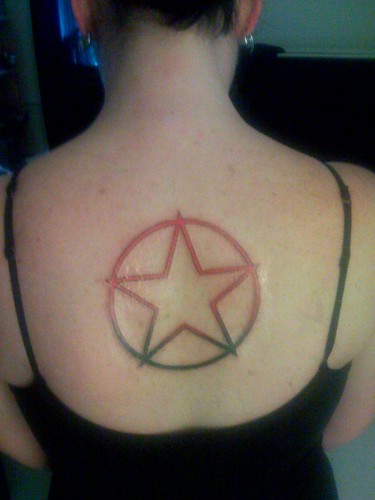
Inked!

This is really only tangentially related to the overall subject of the blog, but...


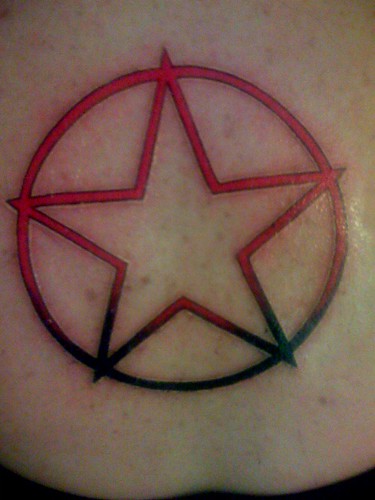
I got new ink!


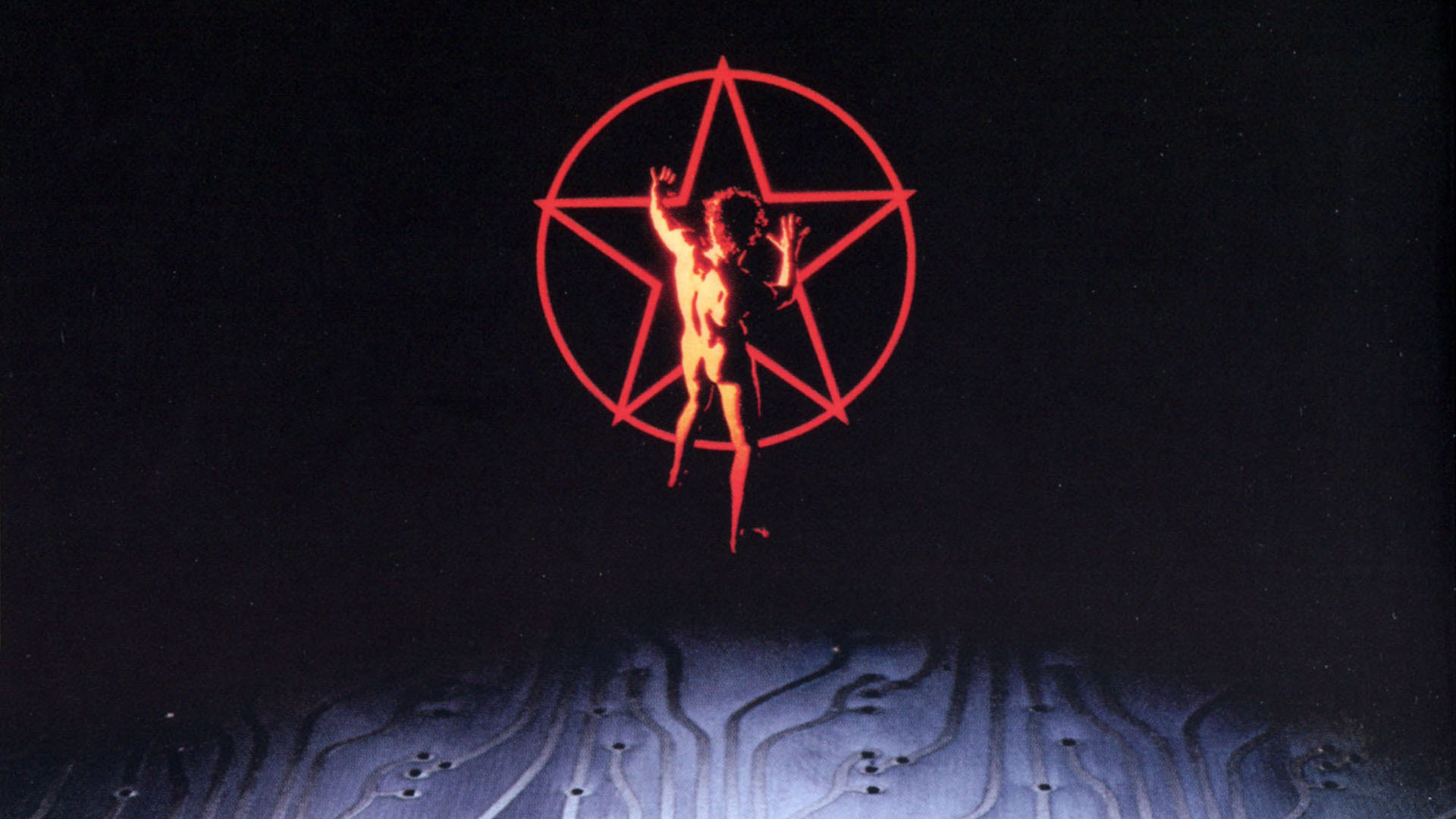
I've been thinking about this design for over a year. It's an adaptation of the Rush Starman (see below), which first appeared on the back of their album 2112.

The original Starman symbolizes "the abstract man against the masses. The red star symbolizes any collectivist mentality" [Neil Peart, Creem, 1982]. I identified so much with that symbolism and the sentiment behind it. I have felt like an individual fighting the masses... My experiences in elementary school and junior high (see the section on the "No Demon")--particularly being told that I shouldn't try to be the best in school because it was threatening the other students--have been a fundamental building block in my worldview and personal philosophies.


I became really enamored with the image, but I wanted to change it a bit if I were to put it on my body. I took the man out of the original because I feel like the abstract man. The placement of the star on my upper back (vice any other part of my body) is to remind me that the pressure is always there, behind me, and that I must stay true to my convictions regardless of what pressures I face, particularly in my art. I also chose to have it on my upper back because the muscles there are the source of strong dance posture, particularly in tribal style. I feel powerful when I contract my back muscles and stand tall, and that posture conveys a sense of control and confidence.

My entire life I've striven to remain an individual, to not compromise myself in the face of peer pressure, trends, and conformity.

And to give credit where credit is very much due... my tattoo artist is Susan Behney-Doyle at Jinx Proof in Washington, DC. She's amazing, and she made my star a reality.

Sunday, May 25, 2008

More words of wisdom from Mr. Peart

My favorite rock drummer, Neil Peart, says this on one of his instructional DVDs:

"Be inspired by your accomplishments and not threatened by your limitations."

I like that!

Hearing that made me think about my own accomplishments and limitations as a dancer and artist. I feel like I have a few accomplishments, achievements that I'm proud of and that I worked really hard to attain. And then I thought of my limitations. My main limitation is time. There's never enough time in the day for me to accomplish all that I want with my art. Sometimes I do feel threatened by my limitations, but I have to look at them as not hindrances but a framework: How much can I do within these boundaries? How much can I push myself within the box of my own schedule and my own limits?

I think as artists it's really easy to be discouraged by those elements of our lives that appear to hold us back from really flourishing.


What do you feel limits you? What are your accomplishments as an artist and as a human? Take a moment to reflect and maybe your limitations are guidelines in disguise.

Wednesday, May 21, 2008

Returning from my fourth Tribal Fest

Tribal Fest. It's like the (pardon the analogy) Mecca of tribal and fusion bellydance. It's where we go to learn from and watch the "stars", and it's where new stars are born and discovered.

And for a little less than a week, you can immerse yourself in this world of fantasy and individuality, if you go in with the right attitude.

It's easy to get wrapped up in the glitz and glitter and infinite searches for "fame." Frankly, there's a whole lot of ass-kissing and schmoozing that goes on at a festival like this one. So many people wanting to talk to the more famous dancers, to have their troupe noticed by the big names, and to get that latest hip (haha... punny!) pair of Melodia pants.

I've inadvertently been sucked into the materialism and external focus that is so prevalent at large gatherings such as this one. It's easy for me to feel like the odd one out, the outsider who isn't cool enough to hang with the popular kids... it's a complex I've had since elementary school... This sense of not being able to relate and feeling like I need to keep up with the Joneses of tribal belly dance leaves me feeling inadequate, inexperienced, and disconnected... not only from the "scene" but myself. It also doesn't help that I'm introverted and have a hard time feeling comfortable around large groups of people, particularly when I don't know most of them.

This year I made a conscious decision to make the most of my time at the fest, regardless of what happened. I think it worked!

I took time away from the fest when I needed to be isolated, and I spent a a leisurely amount of time getting ready for my performance on Friday night. When I got to the festival venue after finishing my hair and make up, I spent at least an hour and a half walking around with my earphones on, listening to Rush (of course!) and just centering myself. I had a few one-on-one conversations with vendors about music and dance and integrity, which also helped to boost my confidence a little bit more. I think that this time alone, in my own little world of music, helped me deliver (what I thought was) a solid performance that night.

I spent the remainder of the festival with my friends, spending time with people who I hadn't seen in months, sometimes years, and enjoying the warmth of the northern California sun. I spent money on things that I knew I would use, not just because they were the "cool new things".

If you look past all the shiny things on the vendors' tables and find a sense of peace within yourself and your abilities as a dancer and as a human being, chances are you'll be less likely to be sucked into the vortex of activity at such a large festival as Tribal Fest. Everyone has a different festival experience, and it's up to you to choose how you approach and spend your time. This year, I feel like I chose very wisely.

Sunday, May 4, 2008

On being a performer.

A stream of consciousness post for a Sunday morning...

I think the hardest part of being a dancer for me is also being a performer. I get a little self-absorbed, and not in a "I'm so awesome" kind of way, but in that I forget that there are others watching me perform. If I'm not in the right headspace, I don't project as much emotion to the audience as I should or could. And then the audience doesn't follow me on my journey on stage.

I am an introvert. I have a hard time connecting with people in general, and when I'm putting myself on stage, expressing very personal elements of myself as a dancer and artist, I feel very vulnerable.

What really helped open my eyes was taking a workshop with Sera, formerly of Washington DC and now in New York. She said that when we're on stage we must "give our throat to the wolves" - basically we have to forget our fears and open ourselves up to the audience, no matter how cruel or aloof they might be.

I've always been a technical dancer - the skill of dancing has come rather easily to me, but connecting with the audience has always been a challenge. I think it's a challenge for most dancers who aspire to also be performers. It's much easier to go out there, do some tricks, and then walk off stage... but to really connect with the audience, to give them a piece of yourself, your soul, is so much different... and it's scary!

What I see in a lot of newer dancers is that they have not yet learned how to project, to give themselves to the audience. Being able to project means being confident in your technical abilities that they become second nature... it's like an actor knowing her lines so well that she doesn't have to think about them anymore and she can become the character that she's portraying.

Recently I've been focusing more on getting into that emotional place than on drilling technique, so that I can just dance "in the moment" and yet still give myself to the audience.

What has really helped me is eye contact. I used to be so afraid of looking people in the eyes, even when not on stage. Honestly, sometimes I fake eye contact when on stage. I'll look between people, and not really at anyone, but it looks like I'm staring someone down. I'm trying to get better at this and really look right at people in the audience. It makes them smile, and it makes me smile. Both good things when on stage!

I also try to spend some time alone before the performance, getting into an emotional place. If I don't have that time before a performance to settle into my "character", the piece isn't going to be as successful, and I have a harder time controlling my emotional projection on stage. When creating a piece, I try to have a particular mood or character that I'm portraying, and these are always a part of myself. I never portray a character that isn't inherent in my own personality.

And while I'm on stage, I have to believe and know that I am in control: of my movements, my expression, and the audience. They are my captives... otherwise they wouldn't be there. It's a delicate balance... because if you try too hard for their attention, it will slip away. The audience will know that you're trying to hard and then they won't take you seriously. But if it's obvious that you're enjoying yourself and loving what you do up on stage, they'll go along with you for the journey. It's very zen. It's trying without effort.

The most useful way to become a performer is, of course, getting performance experience. Nothing will teach you most about being on stage than actually being on stage. You can read all about emotional expression all you want, but if you don't actually perform, none of that intellectual knowledge will do you any good.

Where are you in this process? Is connecting with the audience something that comes naturally for you or not? What do you do to help you with this aspect of performance?

Tuesday, April 1, 2008

Darkness and Light.

I was talking to a fellow dancer yesterday, and we were talking about emotional expression and crying in dance workshops... I said this:

We go into this dance thinking it's all fun and light, but if we really want to get something out of it, we have to face the dark within ourselves.

Some of the best workshops I've ever taken are the ones that have made me cry.... Not because the instructor was mean or overly demanding, but because the dancing has been so physically intense that I let down my emotional guard and the demons that I usually suppress from day to day come knocking on my proverbial door. When I take a moment to cry out my frustrations with myself and my expectations, I realize that I have broken through yet another emotional wall. I emerge victorious, ready to face the world again, having confronted painful memories and conquering them.

So much of our emotional existence is like that of the life of the Phoenix... we constantly immolate ourselves in our self-made fires, only to be reborn, stronger.

Thursday, March 13, 2008

Loving your body: The Physical

I swear I'll get to the music posts... but for now, something a little different: taking care of your body.

This week, for the first time ever, I had to cancel a workshop and performance because of an injury. My iliotibial band in my right leg (shown in the illustration to the right; click for a larger image) has "gone on strike", so to speak. Since Monday, I haven't been able to walk up stairs, sometimes just walk, without being in pain, particularly where the tendon attaches to the iliac crest, at the top.

I am, like many of us, a "can do" kind of person. If I commit to something, I want to follow through. I hate backing out of previous arrangements, particularly when lots of people are relying on me to be there, for them. So for me to admit that I can't be there is very hard.

The experience, however, got me thinking about how my body is my dance career. If I don't take care of it, nurture it, take the time to heal injuries, and rehabilitate myself, I'm doing a greater disservice not only to myself but to those who want to learn from me.

I also started thinking about how many of us approach this dance... like it's easy and always good for us. And, if we practice properly, listening to our body when it needs care, and pushing it to our limits, and not beyond, this dance can bring us great emotional and physical joy.

But I also treat this dance like a sport. I want to sweat. I want to feel "the burn". If I'm not sore the next day after a practice, then I think the practice was too easy. In pushing myself, however, I risk injury, as I often don't have the time to properly rehabilitate my muscles after a hard workout. I'll teach for two hours straight, and instead of taking 30 minutes to an hour to cool down, relax, and recuperate, I take a hurried shower and jump into bed, because it's late, and I have to get up early in the mornings. I think that my body can take it. I am a "can do" person, so I think my body can handle this repetitive physical stress... but this week my body decided that enough was enough. So, I had no choice but to listen to it.

It's important to know our physical boundaries. We need to know when to say, "I'd love to prove to myself that I can do this, but my body won't be healthy if I do." Many of us are self-competitive, and we always want to do better, more, be stronger than we were yesterday. Sometimes our body gives us these little reminders that it needs some love, and it's our responsibility to realize that sometimes proving to ourselves that we're strong might actually be a sign of mental weakness. It takes more strength to be humble and admit that we're on the wrong path than it does to stay stubborn and push ourselves beyond our limits.


Monday, March 10, 2008

Quite the character.

Before I go into my thoughts on the importance of music, I want to share some of my personal history with you all. I swear it's related.

When I was still figure skating, I took classes and lessons with an Armenian woman, Noemi Nargizian, who had danced with the Kirov Ballet during the Cold War. She immigrated to the United States after the Iron Curtain fell and moved to the San Francisco Bay Area, which is where I lived the first 18 years of my life, and where I spent 12 of those 18 years as a competitive figure skater. Although Noemi herself did not skate, she worked with several figure skaters to improve their presence on the ice, character development, musical interpretation, and emotional expression.

She was one of the sweetest and most giving people I have known, as well as humble and incredibly talented. She was always joyful and loved sharing her secrets of the Russian ballet with us, unknown figure skaters who had little experience in the world.

At the time I was working with her, I didn't realize how much her instruction would help me later on as a belly dancer. I still use her lessons today, both in my own performances but also in my classes.

One of the lessons I learned from her was creating a character that was true to your emotional perspective. She said that for every performance I should create a story, something close to my heart that would help me get into "that place" before taking my starting pose on the ice. It had to be something I could relate to personally, and no one else had to know what it was. I loved this concept, and I ran with it. I created a personal story for every skating performance from then on. I credit my doing so, and Noemi's loving training, with winning several awards for Artistic Expression in the competitions I entered.

When I started belly dance, I was so consumed with learning the new dance and learning how to move on a floor instead of slick frozen water, that I forgot about Noemi's wisdom.

It wasn't until 2005, when I took a Level I three-day workshop with Suhaila Salimpour that I started thinking about characters and emotional perspective again. She was talking about her Level III workshops, and how it's all about facing your demons and reaching deep inside to find deep-seated emotions. Then, a few weeks later I took a workshop with another dancer I admire greatly, Sera, from New York. She said that in your performances you have to "give your throat to the wolves". Basically, you can't be afraid to make yourself vulnerable.

At that point I realized that I had lost my perspective.

From then on, I started to approach all of my bellydance performances from a deeply personal level, creating a story behind each, something that would move me and help convey my feelings from the stage to the audience. I started creating characters which were aspects of my true self. I think this rediscovery of my emotional expression helped to elevate my performances to a new level, and helped me connect with my audiences.

If you create a character that you can't relate to, it's not going to work. You have to come from something deep in you, something that creates an immediate emotional reaction when you think about it. You have to feel it inside you, in your heart, in your whole body. For me, it starts with the music. I have to dance to music that invokes a strong emotional response. From there I spin my tale, whatever it might be...

Sunday, March 9, 2008

The Sight of Music

One of the most essential elements in my performances is the music I choose. Music is what drives me to dance. After all, every style of belly dance is all about becoming the music. However, I feel like that essence somehow got lost in the bustling trend of new dancers who identify with the tribal fusion supergenre.

So... I'd like to address these subjects over the course of a few weeks or so...

  1. The importance of dancing, not just performing a series of disconnected movements.

  2. Loving your music.

  3. Not choosing music because you heard someone else using it and you thought it was cool.

  4. Using your music as a springboard to creating an aesthetic for a performance or several performances.

  5. Knowing your music inside and out.

  6. Not allowing yourself or others to pigeonhole you into dancing to certain styles of music.


Stay tuned...

Thursday, March 6, 2008

Stillness and Nothingness

Or, how you can conquer creative burn-out.


The Artist as Sisyphus
"The struggle itself is enough to fill a man's heart. One must imagine Sisyphus happy." - Albert Camus

Artists, it seems, put a tremendous amount of pressure on themselves to be creative, productive, and successful (not necessarily but sometimes in the monetary sense) all the time.

When we're not creating something new or acting on newfound inspiration, we easily get down on ourselves, questioning why we're not living up to our constantly climbing expectations. Many of us are not only seeking to create and innovate regularly, we're striving to produce art all the time. Because, well, we're artists!

We are self made Sisypheans: Pushing our rock up the hill eternally, only to reach the top and lose our grip, and the rock comes tumbling down, erasing our accomplishments... While this is an inherent element of being an artist, the uphill struggle can be exhausting. This is burn out.

Sometimes you just need to step away from the stone and let it sit at the bottom of the hill.

Zen and the Art of Bellydance
"As long as you seek for something, you will get the shadow of reality and not reality itself." - Shunryu Suzuki

Throughout the years I have discovered that being creative, as well as all learning many other aspects of this dance, is an experiment in Zen. The Oracle (Wikipedia) tells us that "Zen is notable for its emphasis on mindful acceptance of the present moment, spontaneous action, and letting go of self-conscious, judgmental thinking." I'm hardly an expert on Eastern philosophy, but my experiences with dance have been that when I let go of my self-criticism, my high expectations, and accept where I am at this moment, I progress much further in my art than when I force it.

I've noticed that my students are more likely to accomplish a troublesome movement when they take a moment to just play with it, releasing the inner analyst and critic. They beautifully perform the movement without thinking about it. I find this to be true with myself, as well. If I approach the movement without analyzing it, without forcing it, the more effortless and natural that movement becomes. Just as with technique, this is also true for the creative process.

Let your art happen independently of you.


Clearing the Creative Clutter
"The quieter you become, the more you can hear." - Baba Ram Dass

To pause the constant stream of dance aspirations in my head, I like to involve myself in activities completely unrelated to my artistic pursuits. No listening to potential dance music. No searching for new costuming ideas. No shopping for new DVDs, and no watching of dance performance or instructional DVDs. (I will, however, answer e-mails and phone calls related to the business end of my dancing, as that does not seem to interfere much with my creative process, but your experience might be different.) Eschewing these activities is the equivalent of a creative fast.

My favorite activity is listening to music to which I have no intention of dancing. For me, this usually means progressive rock like Rush (of course), Yes, Dream Theater, and others. The works of J. S. Bach also help clear out my creative clutter.

If you're constantly working on costuming, try putting it aside and working on a different craft. If you're constantly watching dance instructional or performance videos, watch something different, and don't seek inspiration in whatever new program you choose to watch. Just enjoy watching it for the program's sake. If you're constantly reading newsgroups that only focus on dance, stop reading those newsgroups for a while and read a book unrelated to dance or to creativity. (I love science writing, but I know that's certainly not something that appeals to all of you.) Sometimes it is good to stay in touch with what others are discussing, but it's easy to get sucked in to the endless dribble of dance drama as well. I find that those newsgroups offer lots of chaff and not a lot of wheat.

Find an activity you enjoy that is unrelated to your creative pursuits. Immerse yourself in that activity, relish it, and you'll find yourself feeling mentally and emotionally refreshed. And most importantly, (I think this is the most difficult part for us) give yourself permission to step away. Time away from your art will do you no good if you constantly feel guilty for not creating. You must consider your creative break as a gift to yourself.


The Enjoyment of Now
No thought, no reflection, no analysis, no cultivation, no intention; let it settle itself....

By turning your focus away from your creative pursuits (in my case, dance), you'll find yourself focusing on the enjoyment of now, rather than the anxiety of making your next great artistic creation. Your enjoyment of now will help you quiet your judgemental mind, your No Demon, your doubts and fears.

Why is Now so difficult to enjoy? Because once you recognize it, it's gone. That tiny point between the cones in the somewhat esoteric image above is Now. Compared with the history of what has happened and the possibilities of what is to come, Now is miniscule. But that doesn't mean you can't revel in it when you're there. And you're there right now. And now. And now.

Permission to Stop
Allow yourself time away from your art. Acknowledge it as healthy, refreshing, replenishing, and nourishing to your artistic self. When you feel the loom of burn-out approaching, recognize it, and take that moment to still your creative quests and refill your artistic well.

Wednesday, February 20, 2008

Confident Humility.

Where is that line between being confident in your abilities, and yet remaining (or becoming) humble about them?

I think that there's a spectrum.


Self-Doubting ------------------ | ----------------- Self-Absorbed


As an artist, and as a human being, I think I'd like to be somewhere in the middle: sure of myself to be able to sell myself without self-doubt creeping in to cripple my efforts, yet humble to genuinely accept and appreciate feedback and to evaluate my art and actions and accept criticism about them.

I think that I fall somewhere around here:


Self-Doubting -----------*me*------- | ----------------- Self-Absorbed


For me, my self-doubt comes from my need to be better than I am wherever I am in my journey as an artist. Most of the time this is healthy ambition that drives me to improve.

However, self-questioning can easily turn to self-doubt, and with self-doubt comes looking outward for approval from other people, comparing myself to others (where it's not warranted), and generally letting my insecurities handicap my self-esteem. I don't think I'm as good a dancer as I could be. I could certainly practice more. I could probably engage more with my students. I struggle, as many of us do, with finding my identity as an artist, particularly after several comments from the uninformed implying that I dance very much like other more well-known tribal fusion artists.

If we think about our weaknesses more than we focus on our strengths, we can slide backwards into detrimental self-doubt and insecurity.

Whereas, self-absorption is looking inward and seeing only or mostly great things. From what I can imagine, an artist who is self-absorbed is slow to consider criticism and "try it on", they see themselves as more accomplished than their colleagues, and have a hard time talking about anyone but themselves. Compliments, to the self-absorbed, are mere confirmations of what they already know. "Yes," they say inside, "I am fabulous." Frankly, I have a hard time putting myself in the self-absorbed's shoes.

Where does that leave us?
Accept compliments when you receive them. Even if they're nothing more than ass-kissing, accept them and let them bring you a little bit of joy. Accepting a compliment with humility and honesty forces you to open up your heart a little to the person offering the compliment. Yes, this makes you temporarily vulnerable, but that which scares us makes us stronger. Thank the person and mean it.

Accept criticism when you receive it. Even if it's as dumb as "OMG, I HATE the way she wears those bracelets." Allowing yourself to consider criticism also makes you vulnerable because you are questioning that which you believe in, but welcoming in criticism also makes us stronger. Try it on; see if it fits. Maybe those bracelets weren't flattering afterall.

We must strive to find a balance. Without self-assuredness, we can't promote ourselves. We'll constantly think we aren't good enough to be "out there" and we'll sell ourselves short. But if we slide too much the other direction, we can cease learning, never believing we owe anything to anyone, completely consumed by our own perceived greatness.